Useful medical isotopes are hard to manufacture at scale
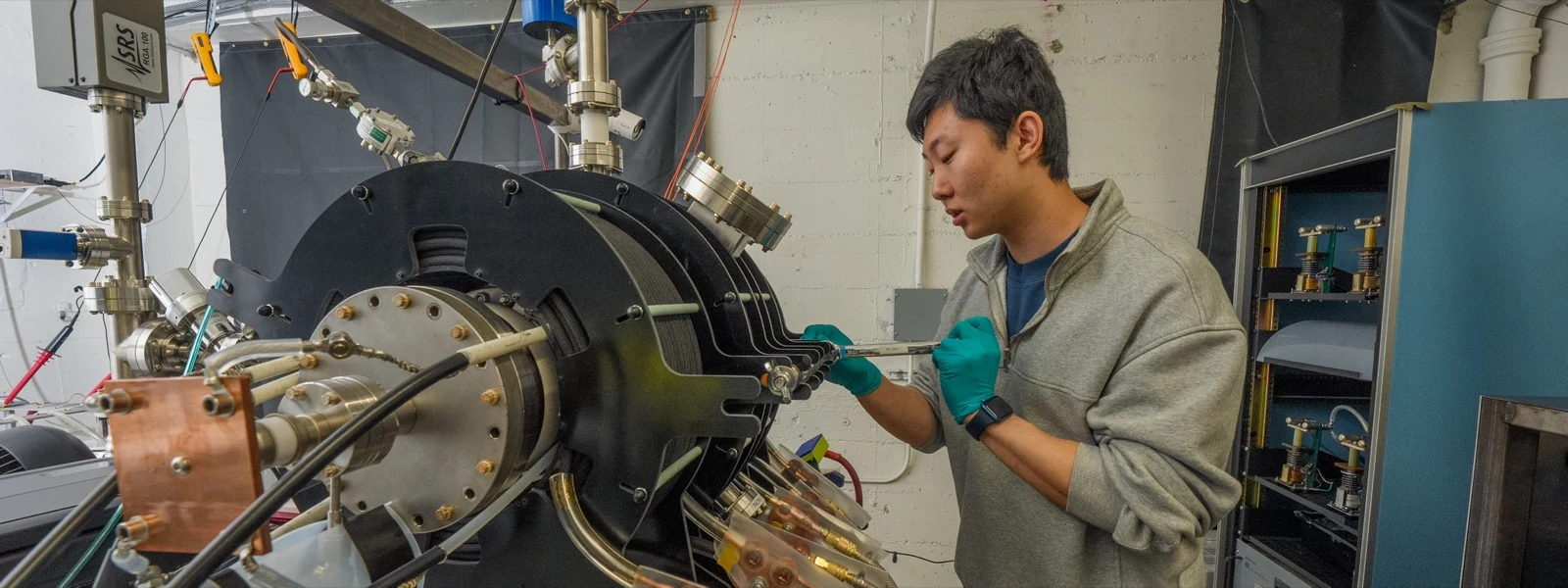
Jason Parisi, PhD, is chief science officer of Marathon Fusion and a former staff research scientist at Princeton Plasma Physics Laboratory. Adam Rutkowski, a former SpaceX propulsion engineer and Princeton plasma physics PhD candidate, founded Marathon in 2023 with Kyle Schiller, previously a science policy fellow at Schmidt Futures. The company has raised $18 million in funding, including from the U.S. Department of Energy, and approaches fusion as a source of valuable nuclear reactions as well as future electricity.
An isotope is a form of an element with a particular number of neutrons in its nucleus; copper-64, for one, can help doctors image cancer. For Parisi, making the useful versions is a search problem: a desired nucleus does not identify the best starting material, particle beam or chemical separation, and a route that yields the right isotope can still be useless if the product cannot be recovered efficiently or costs too much at scale. At Demo Day, Parisi called the difficulty a “combinatorial explosion.”
Terbium-149 shows the stakes. Its alpha particles deposit energy over a short distance in tissue, and its positron signal offers a way to image where the material goes, a possible pairing of treatment and imaging. Marathon’s terbium preprint puts current worldwide delivery to end users at about one gigabecquerel annually, equivalent to only 20 hypothetical 50-megabecquerel doses.
Two preprints put numbers on isotope supply routes
-
Preprints published Sept. 7 and Sept. 22. Parisi published both inside Reactorfield’s first cohort, detailing AI discovered pathways to produce Tb-149 and Ac-225. In October, Ac-225 (RYZ101) was just announced to have met its primary progression-free survival (PFS) endpoint, in a Phase 3 clinical trial, beating standard of care.
-
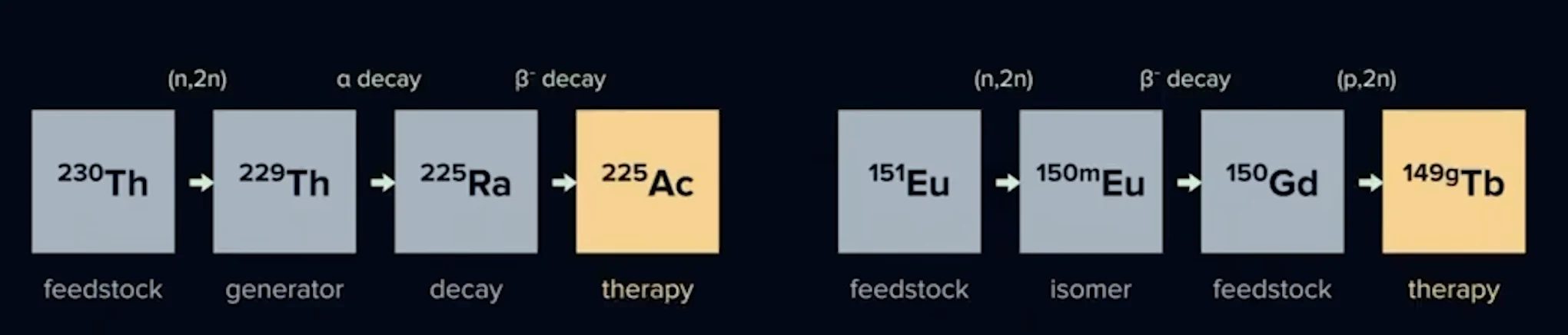
The model predicts about 250 curies of thorium-229. The Sept. 7 preprint models a 10-megawatt deuterium-tritium neutron source irradiating thorium containing 27 percent thorium-230 for six months, a yield initially sufficient for about five million actinium-225 dose-equivalents annually. Thorium-229 is a generator parent, whose decay continually supplies a shorter-lived isotope, and its 7,916-year half-life gives the modeled stockpile an unusually long working life.
-
Predicted: about 1,200 to 2,900 dose-equivalents per irradiation. The Sept. 22 preprint predicts that range for terbium-149 from a four-hour, 100-microamp irradiation in a high-yield configuration, assuming 50-megabecquerel doses, and identifies more than 700 reported cyclotrons with sufficient beam energy for the second step of its two-stage route. The configuration trades purity for yield, the therapeutic dose remains unestablished, and the central reaction rates require direct measurement.
-
Ship the precursor, make terbium-149 locally. Terbium-149’s half-life is only about 4.1 hours, so a centralized producer loses much of the product while shipping it. Marathon’s Sept. 24 release describes making the precursor gadolinium-150 centrally and sending it to local cyclotrons that make terbium-149 near the point of use; the precursor’s roughly 1.8-million-year half-life permits stockpiling without meaningful radioactive losses in transit.
-
Parisi presented Cookbook at Demo Day. The system asks how much of a target isotope a route produces, whether it can be separated from the irradiated material and whether the route stays sensible at the required scale, with a calculation in one field becoming an input to another. He aims to build the “AlphaFold, for Nuclear Fusion.”
Next comes measuring the reactions and open sourcing the tool for all to use
The next decisive result will come from measuring the reactions of the preprints model. In Marathon’s public release, Parisi put it plainly: “The important thing now is to test it.” At Demo Day, he also set out plans to release an open-source version of Cookbook and extend the approach to unresolved nuclear-physics problems.
The Tb-149 work addresses the supply needed to test treatment-and-imaging medicines; it does not establish their clinical efficacy. They also published work on Ac-225, which in October, was announced to have met its primary progression-free survival (PFS) endpoint during a Phase 3 clinical trial. Both preprints are public and detailed enough to expose their assumptions to other researchers.