Documentation gaps can hold up trials and delay therapies for patients
Retro Biosciences was founded with an ambitious goal: extending healthy human lifespan by ten years. Backed from its earliest days by Sam Altman, who provided an initial $180 million in funding, the company is pursuing therapies targeting the biological mechanisms of aging. In May 2026, Retro announced a financing round at a $1.8 billion pre-money valuation, reflecting the scale of the effort.
Yuuki Hosokawa is a scientist in analytical development and quality at Retro Biosciences, a role concerned with how a therapy is measured and whether the measurements can support its use. His work sits at the final checkpoint before a drug reaches a human trial: tests of safety, purity and potency, and procedures that explain how those tests work and justify the conclusions drawn from them. At Demo Day, he said gaps in documentation submitted to the FDA or EMA can cause a clinical trial hold or rejection, costing months and millions of dollars and “delaying therapies for patients.”
A cell-counting procedure, for example, governs which images an operator accepts, how cell aggregates are handled and when a sample must be assessed again. Any ambiguity leaves room for different decisions from the same measurement. Before Reactorfield, Hosokawa’s reference library held more than 700 quality and regulatory PDFs, and reviewing that material and drafting procedures took more than 40 hours of work.
Retro’s oral autophagy drug RTR242 went from selecting an indication to first human dosing in just 15 months. At that pace, quality review has to keep up with the science.
Procedures came back with comments that experts could accept or reject
-
The prototype caught additional issues before final approval. Hosokawa’s Demo Day slide stated: “The MVP saved time and caught additional issues, helping our experts strengthen the documentation before final approval.”
-
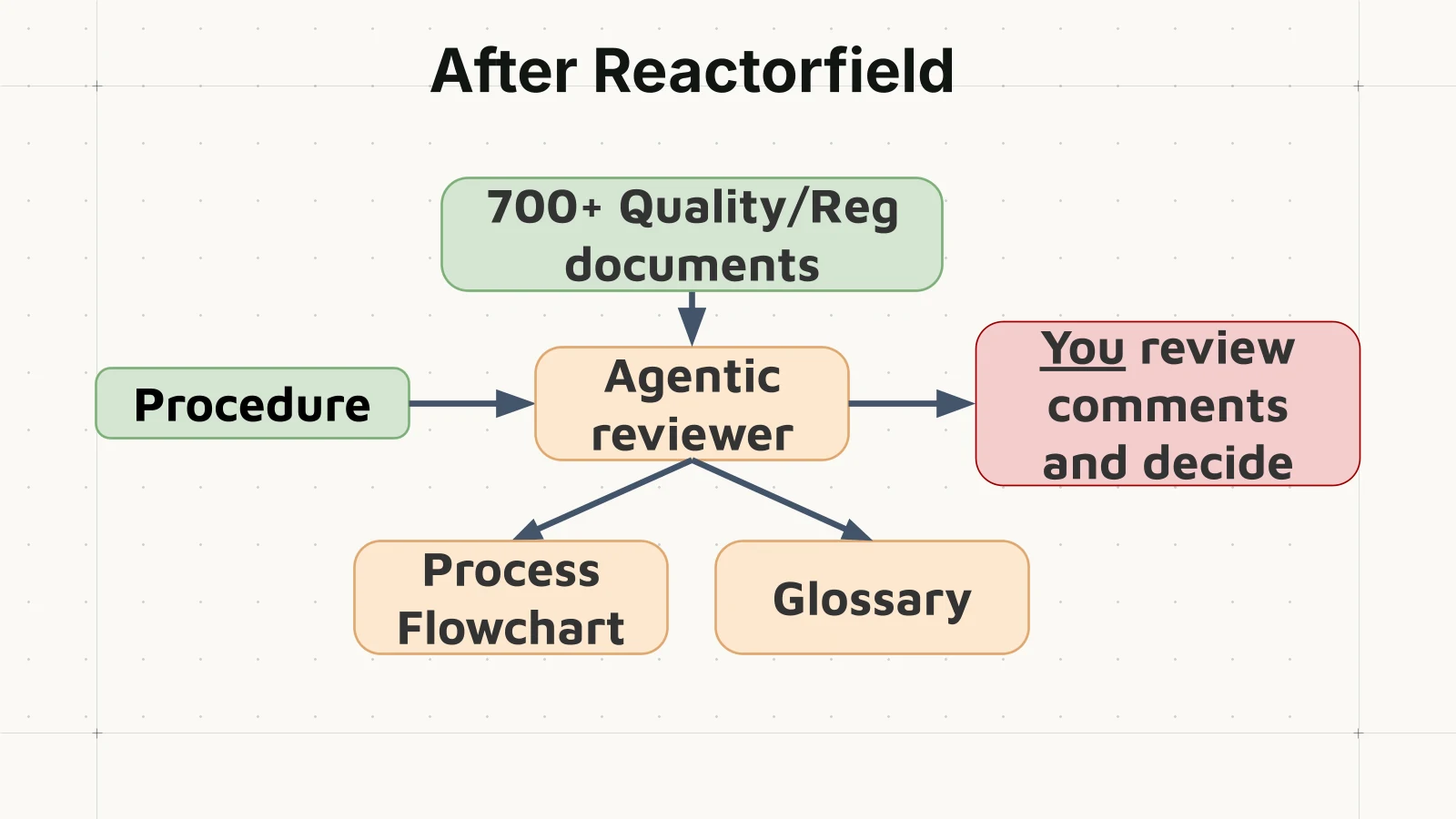
An MVP followed the design a week later. In the second week of the Reactorfield program, Hosokawa designed a system that would accept a standard operating procedure, review its alignment with quality expectations and produce a flowchart after revisions. A week later, he had built a minimum viable product.
-
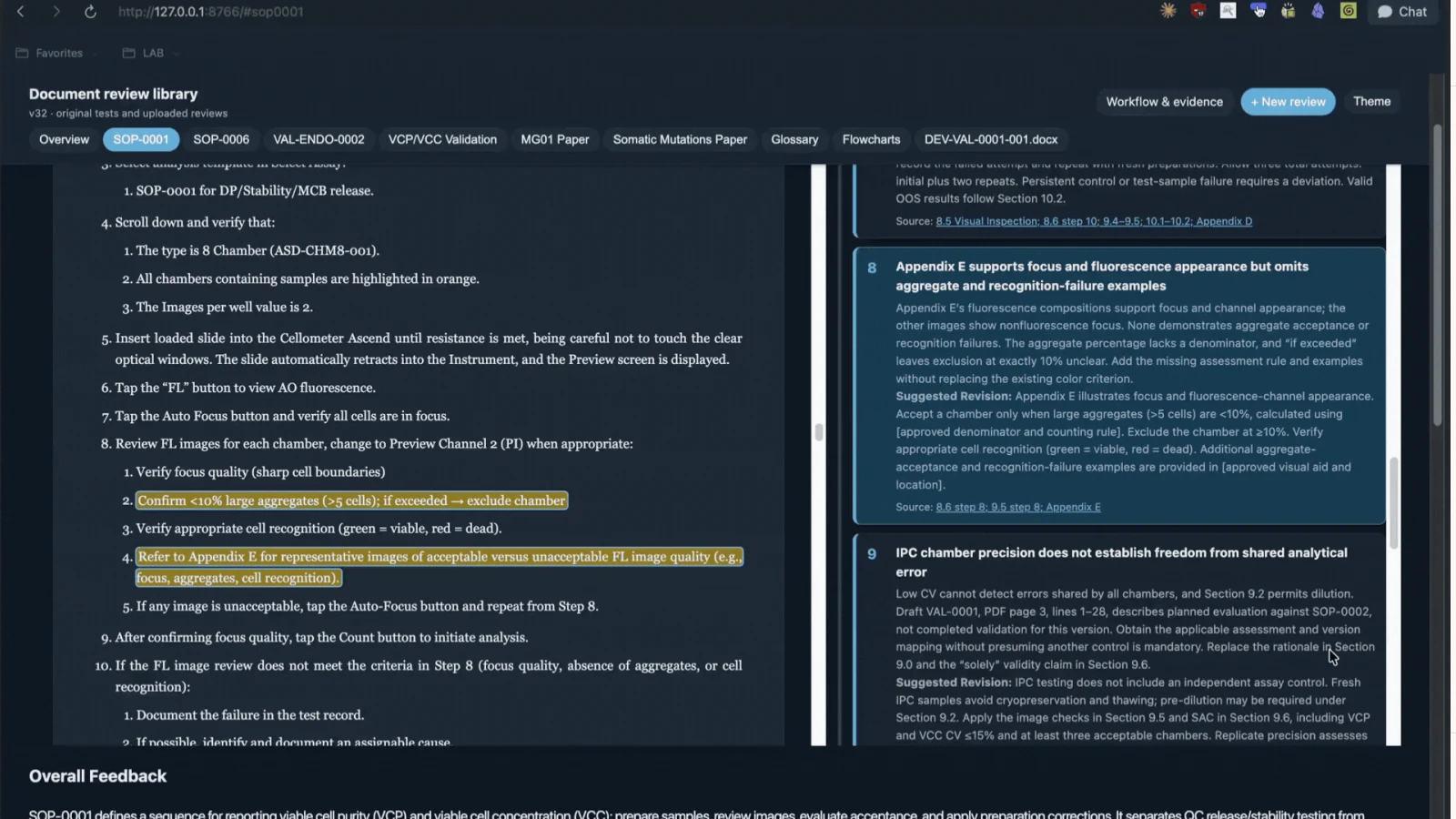
Experts accept or reject every suggested change. “After Reactorfield, we built an agentic reviewer that aligns procedures, test methods, SOPs with the 700 plus quality and regulatory documents,” Hosokawa said at Demo Day. In his demonstration, the reviewer checked a procedure against that library and returned inline comments, a glossary and a process flowchart. Each suggested change sat beside the original text, and the quality expert remains responsible for the final document.
-
A flowchart turned a dense procedure into steps. In a bacterial endotoxin testing procedure, Hosokawa mapped sample selection, thawing and dilution through reader preparation, loading and measurement. He emphasized that the flowchart helped translate a dense document into a process another person could follow.
-
A 10% aggregate limit lacked a denominator. One cell-counting procedure told operators to accept images with fewer than 10% large aggregates, defined as clusters of more than five cells, and to exclude a chamber if the limit was exceeded. A comment shown beside it in the interface noted the missing denominator, the unclear treatment of exactly 10% and a mismatch between the promised examples of acceptable images and those in the appendix.
-
Agreeing chambers can still share an error. A second comment challenged the use of agreement between measurement chambers as evidence against analytical error and requested the applicable assessment and validation version before relying on that rationale. Measurements can agree with one another while sharing the same error.
- Defined inputs and outputs shaped the build. Reactorfield helped Hosokawa divide the project into modules with defined inputs and outputs. At the Reactorfield Cohort 1 wrap-up, he said writing down the inputs and outputs had helped him clarify what the project should deliver.
What an AI quality reviewer means for getting therapies to patients
Hosokawa’s next steps are to bring the reviewer into daily work, validate it across more procedures and expand its scope. The demonstration did not establish the accuracy of the underlying assay or the reviewer’s ability to find every defect.
He has also begun exploring the reviewer for pre-IND preparation on Retro’s hematopoietic stem-cell program, where the team seeks regulatory feedback before an investigational new drug application. The next question is whether the reviewer can follow the rationale across documents, from how a cell product is handled to which measurements support its release.
Every therapy Retro hopes to bring to patients has to pass the same checkpoint: procedures that show regulators how safety, purity and potency were measured and why the results can be trusted. No single expert can hold more than 700 reference documents in mind at once; an AI reviewer can check a procedure against all of them and place each question beside the passage it concerns. Hosokawa’s reviewer keeps the quality expert in charge of every decision and hands the search to AI. For a company aiming to add 10 healthy years to human life, a final checkpoint that moves as fast as the lab is how those years reach patients sooner.