A gel swarm’s behavior depends on how its units interact
Kathy Liu is a doctoral researcher in Joanna Aizenberg’s group at Harvard. At 17, she won a $50,000 Intel Foundation Young Scientist Award at the 2016 International Science and Engineering Fair for research on safer battery electrolytes. At Stanford, she researched skin-inspired electronic materials and tissue-interfacing gels in Zhenan Bao’s laboratory, then spent a Fulbright year at the University of Groningen synthesizing molecular motors with Ben Feringa, a 2016 Nobel laureate in chemistry.
Liu’s gel RoboSwarms are made of units, each roughly the size of an eyelash, that can move, assemble and separate again; her demonstration slide attributed directed movement to manually moving a magnet beneath the sample. Each unit’s geometry and chemistry shape how the swarm behaves, and Liu explained at Demo Day that the physics of individual materials was better established than the collective behavior she wanted to design. These swarms could serve uses from busting a blood clot or dissolving a tumor to an injectable neural electrode, but each use requires its own design.
Finding a working design meant designing units, microfabricating molds, performing the chemistry, releasing the swarms and testing them. Simulation added a second loop: her mathematics collaborator, by Liu’s account the one math professor in the world running these simulations, ran a model, sent results and waited for her assessment, an exchange Liu called “email pong.”
Three weeks produced a swarm library, a virtual lab and an electrode design
- Three milestones arrived in three weeks. At Demo Day, Liu showed them side by side: a library of swarm designs, a virtual laboratory and an optimized, simulated injectable electrode, each labeled as a year of work compressed into one Reactorfield week, her estimate of the previous research pace.
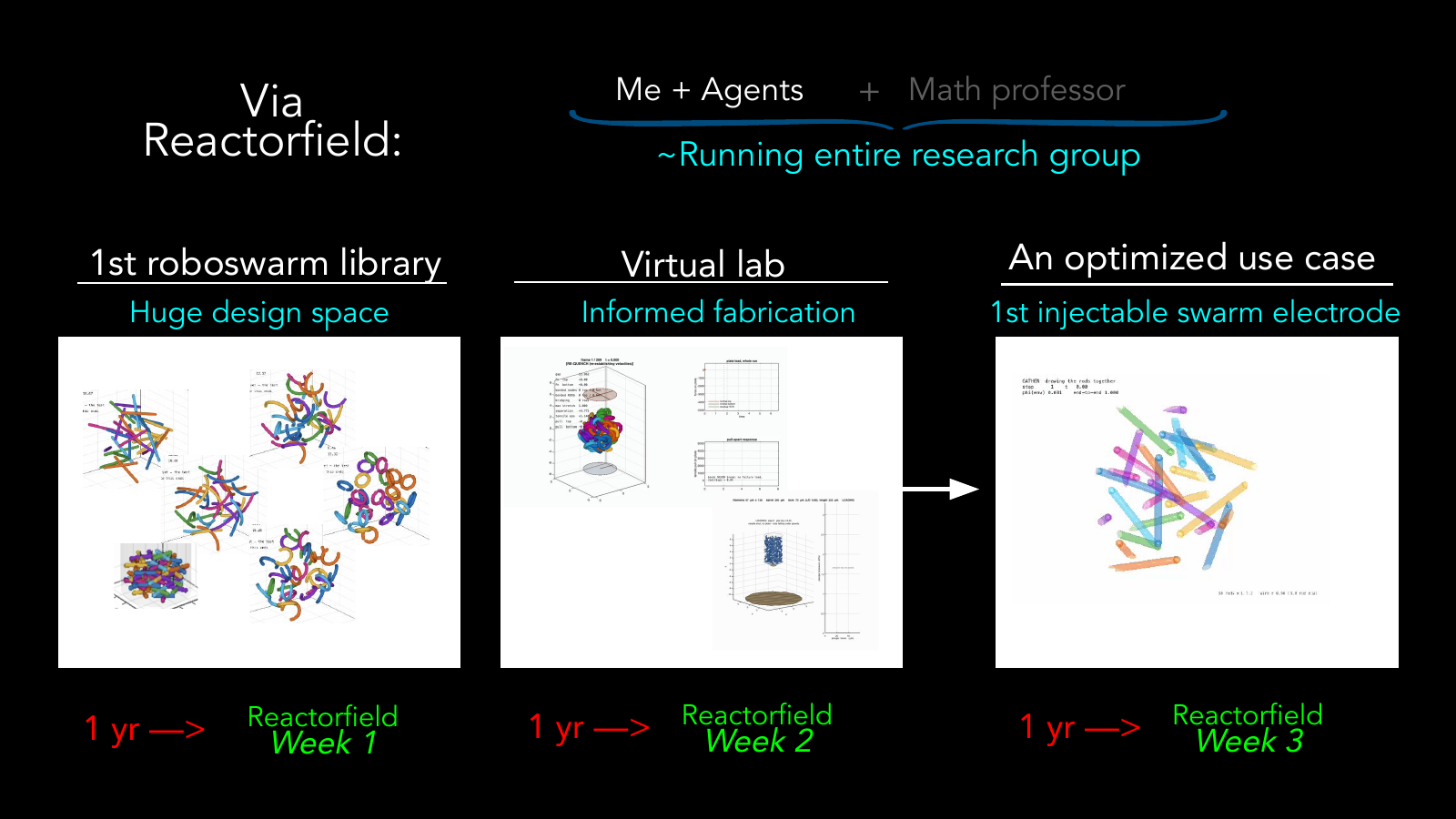
- Liu began running the physics herself. Reactorfield was, in Liu’s words, “my catalyst to hit the download button on Claude Code,” and she began working with a team of agents on the existing physics. Her collaborator stayed on the project while Liu explored designs directly, bringing her experimental knowledge to each iteration.
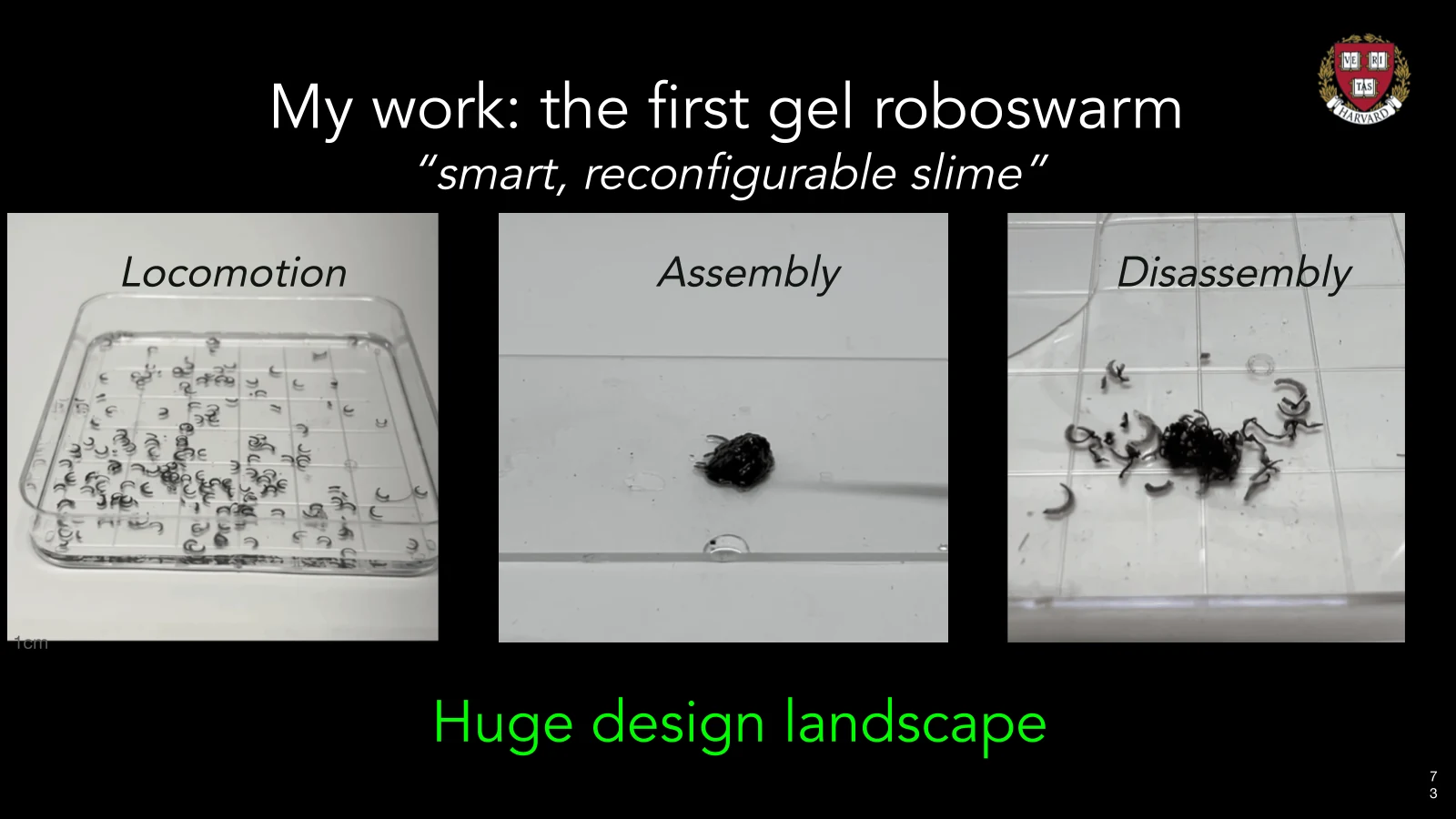
-
One simulated rod expanded to many. Working with her agents, Liu started from her collaborator’s single-rod code, then added full video rendering and extended the simulation to five rods and then 10.
-
Entanglement became a search target. She then ran a systematic search across rod length and curling speed that measured how much the rods contacted and entangled, directing the agents toward more entangled swarms.
-
Liu designed virtual tests for twisting and injection. A virtual rheometer, a simulated instrument for probing a material’s mechanical response, twisted the swarm between plates, and an injection test tracked the force needed to push a swarm through a syringe. Those outputs, tied to real use, gave the agents something specific to optimize.
-
A biased starting setup was caught and corrected. In a Reactorfield Office Hours session, Liu described how she and her collaborator found a bias in the initial placement of simulated rods: the starting conditions did not represent the physical experiment they intended. After she fed that correction back, the system produced more physically accurate simulations.
-
The electrode targets the celiac plexus. Surgeons had asked Liu to investigate stimulating this irregular nerve network deep in the abdomen near the aorta, which they could not currently reach with the bioelectronics they wanted to use. Her proposed design injects separate gel units that assemble around the nerves, with conductive chemistry allowing the assembled swarm to serve as an electrode. The goal is a neural implant that could be injected instead of placed through open surgery.
-
A back burner project reached a new result, with AI. Liu and her collaborators had put the concept aside because they did not think they had time to attempt it. With AI, she explored the search space and optimized a design in her third Reactorfield week. The intended outcome is treating gastroparesis, a disorder in which the stomach empties food too slowly despite the absence of a blockage. Liu noted at Demo Day that the disease has no cure and that people on GLP-1 medications face four times the risk of it compared with other obesity drugs.
What injectable swarms could mean for bioelectronics
The electrode is a design produced through simulation; its performance in physical material and biological tissue remains to be established. Next comes choosing which simulated geometry keeps useful assembly behavior after injection when made with the required chemistry, then fabricating and testing it to see whether the swarm can provide the interface needed for stimulation studies.
Liu’s next step is more computing power: her final Demo Day slide asked for GPUs to explore the design space, study the underlying physics and develop new applications in simulation. If the swarm works, access to the celiac plexus could let researchers study how localized electrical stimulation influences stomach function; Liu also described blood-glucose and insulin regulation as potential research directions, which remain hypotheses.
The larger shift is in who runs the physics. Instead of playing email pong, an experimentalist can now direct a team of agents, test swarm designs in the cloud and decide what is worth fabricating. Liu’s aim is to rethink gels “from something passive like toothpaste to something that has swarm intelligence,” and injectable swarm electrodes could one day reach nerve structures “that no one has access to yet.”