Every new part needs a manufacturing decision before it is cut
Jakob Knudsen is co-founder and CEO of Foundation Industries, which pairs its own CNC manufacturing operation with software that reviews CAD (computer-aided design) files. The company recently moved into 22,000 square feet of manufacturing space in Belmont, California, and serves customers including Skydio, Westmag, Scale AI and Base Power. Foundation began as SAVA Robotics in Y Combinator’s spring 2025 batch, with a 250-pound robot for operating a CNC press brake, a machine that bends sheet metal.
Physical AI is accelerating, and Knudsen argued at Demo Day that design is no longer the slow step: “Design engineers have never been able to move this fast, and yet the bottleneck is manufacturing.” The review tool targets components for drones, robots, aircraft and other hardware whose designs keep changing. A complex part can contain thousands of features, and Knudsen said inspecting one could occupy a machinist with 10 or 20 years of experience for three to four hours. A missed constraint sends an accepted quote back for redesign. Knudsen put the delay in a software engineer’s terms: imagine emailing someone to run a test, then waiting a week for the result to arrive in the mail.
Knudsen built the reviewer during Reactorfield’s Cohort 1 program. Working with Reactorfield’s James Sinka and Berk Ozer to map where AI could apply across the manufacturing stack, from quoting to delivery, he singled out design review for manufacturability.
A reviewer that sorts blockers from easier changes
-
Part-review turnaround improved tenfold. A design that once occupied an experienced machinist for three to four hours can now receive an initial assessment in minutes. The web tool separates features that would prevent manufacturing from changes that would simply make the job easier.
-
The first plan proposed about 20 views. During Reactorfield Office Hours, Knudsen and the Reactorfield team discussed giving a model about 20 views of a part along with basic manufacturing rules. The discussion proposed putting machining knowledge, such as which channels a tool could reach and when a part would need repositioning, into a rules file with explicit cases to defer to a machinist.
-
Knudsen had a working dashboard in about two weeks. At a Reactorfield group Office Hour, the dashboard already distinguished hard blockers from improvements such as matching radii; a week later, multi-file uploading, cross-comparison and manufacturability callouts were working together.
-
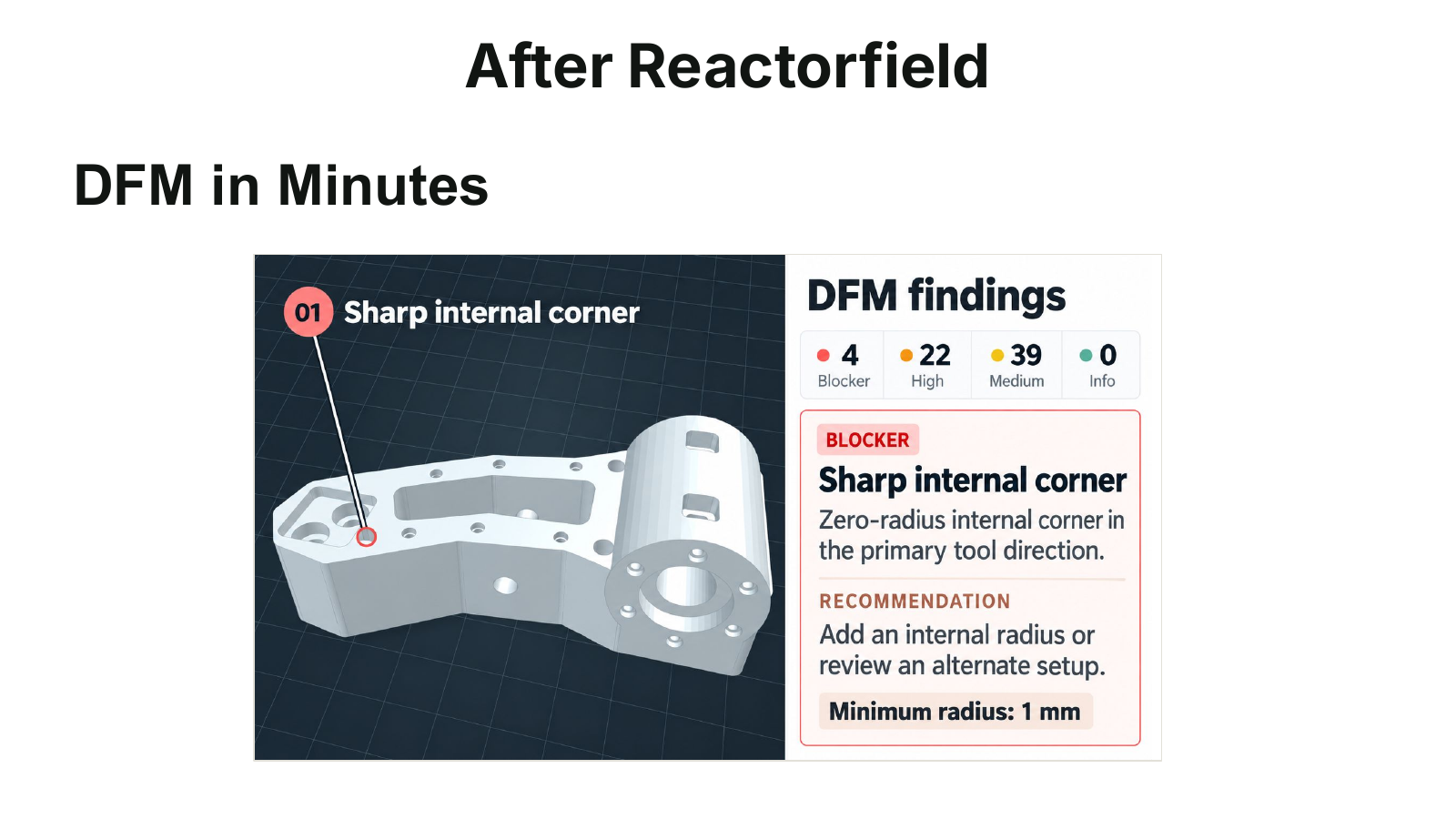
A sample part returned four blockers. At Demo Day, the reviewer flagged a zero-radius internal corner in the primary tool direction and recommended an internal radius of at least one millimeter or a review of an alternate setup. That corner was one of four blockers on a part that also produced 22 high-severity issues and 39 medium ones.
-
Foundation believed an agent ordered a part. At Demo Day, Knudsen said Foundation believed an AI agent had both designed and ordered a part through its platform, a glimpse of the customer he expects to serve more often.
-
Foundation closed its seed round. By Demo Day, the company had also hired a head of software and another mechanical engineer.
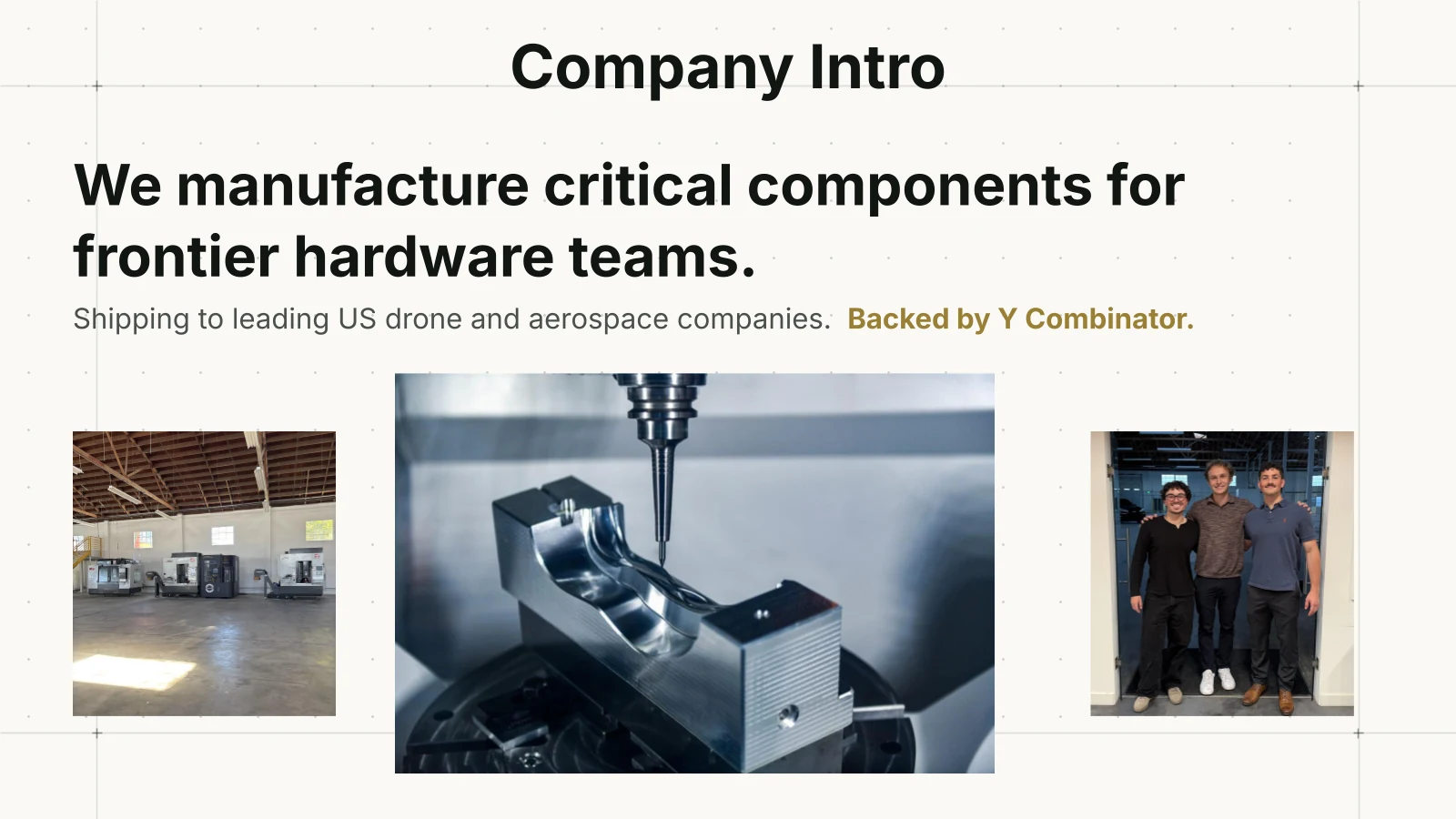
- Reactorfield sparked company hackathons, every two weeks. At the Reactorfield Cohort 1 wrap-up, Knudsen shared how the experience inspired Foundation Industries to introduce internal weekly hackathons. The practice carries forward the spirit of experimentation and building that began during Reactorfield, sustaining that momentum well beyond the fellowship.
What this means for frontier hardware and physical AI
Knudsen’s larger vision is what he called a “physical recursive loop,” in which software designs a part, places an order, receives manufacturing feedback and learns from the shipped result. The team described plans to acquire hardware that would produce a topographic map of a finished part and overlay it on the original STEP file, the digital representation of the component. The current tool does not establish that every manufacturability constraint is detected or that the finished part meets specification; those questions require comparison with expert review and the manufactured object.
As generative design software and AI agents produce more of the plans for physical parts, Foundation aims to serve as the physical world API for the frontier: the place where a design becomes a finished part, and where every shipped part informs the next design.