
AI for Science had one of the best weeks ever. Two announcements, same week:
- Anthropic launched Claude Science. An AI workbench built for research, with scientific tools, databases, compute, agents, code, figures, and review all in one place.
- OpenAI launched GeneBench-Pro. An AI agent benchmark for computational biology.
The 2 biggest frontier labs in the world, launched 2 AI x science products in just seven days. That isn’t a coincidence.
It will be remembered as the “Claude Code” moment for science.
Here’s what that means, and why, if you’re a scientist still on the fence about AI, this is the week to stop and look.
What I mean by Claude Code moment. And why it's BIG.
I've spent my career in software. In 2019 I built SenpAI (YC S21), a real-time AI gaming assistant used by millions of players, even before GPT-3 existed. The first version took a team of 5 and 3 months of heavy sprints at full startup intensity.
2 months ago I casually rebuilt the core of SenpAI myself, in a 3-hour weekend project, talking to my phone. I didn't even open my desktop.
A Hermes agent with the right harness ran the loops for me: multiple agents, each with its own skills, splitting up the design, the build, the review, and the testing.
This is what I mean by the Claude Code moment.
- It collapsed the hard work of 5 people over 3 months into a casual 3-hour project.
- And it changed how software engineers ship. Instead of hand-writing every line of code, they describe a goal, spawn a team of specialized agents, review the outputs, and steer the loop.
In less than 2 years, I watched AI fundamentally change how software engineers get things done. It has barely reached scientists yet. But last week, I believe, is when that started to change.
From "Help" to "Run"
Six months ago, Anthropic said Claude could help with the work of life sciences R&D.
This time they went further:
"Claude can run the work. Not help with it, not accelerate it, run it.”
Claude Science is not just another chatbot for papers. Just like how Anthropic positioned Claude Code for developers and Claude Cowork for knowledge work, now Claude Science is for scientists.
Software has a loop: write, run, fix, run again.
Science has the original loop: “Design the experiment, run it, analyze the data, ask the next question.”
The experiment happens at the bench. The analysis happens at a keyboard.
Claude Science is built for that part of the loop: the part where data becomes insight, figures, decisions, and the next experiment.
What Claude Science actually is
Claude Science is a workbench that runs the research loop, not another chatbot for science. You give it a goal, not a task. It runs a team of sub-agents, so you direct the work instead of doing it. This is how it was meant to be. Now, everyone in the lab gets to work like a PI.
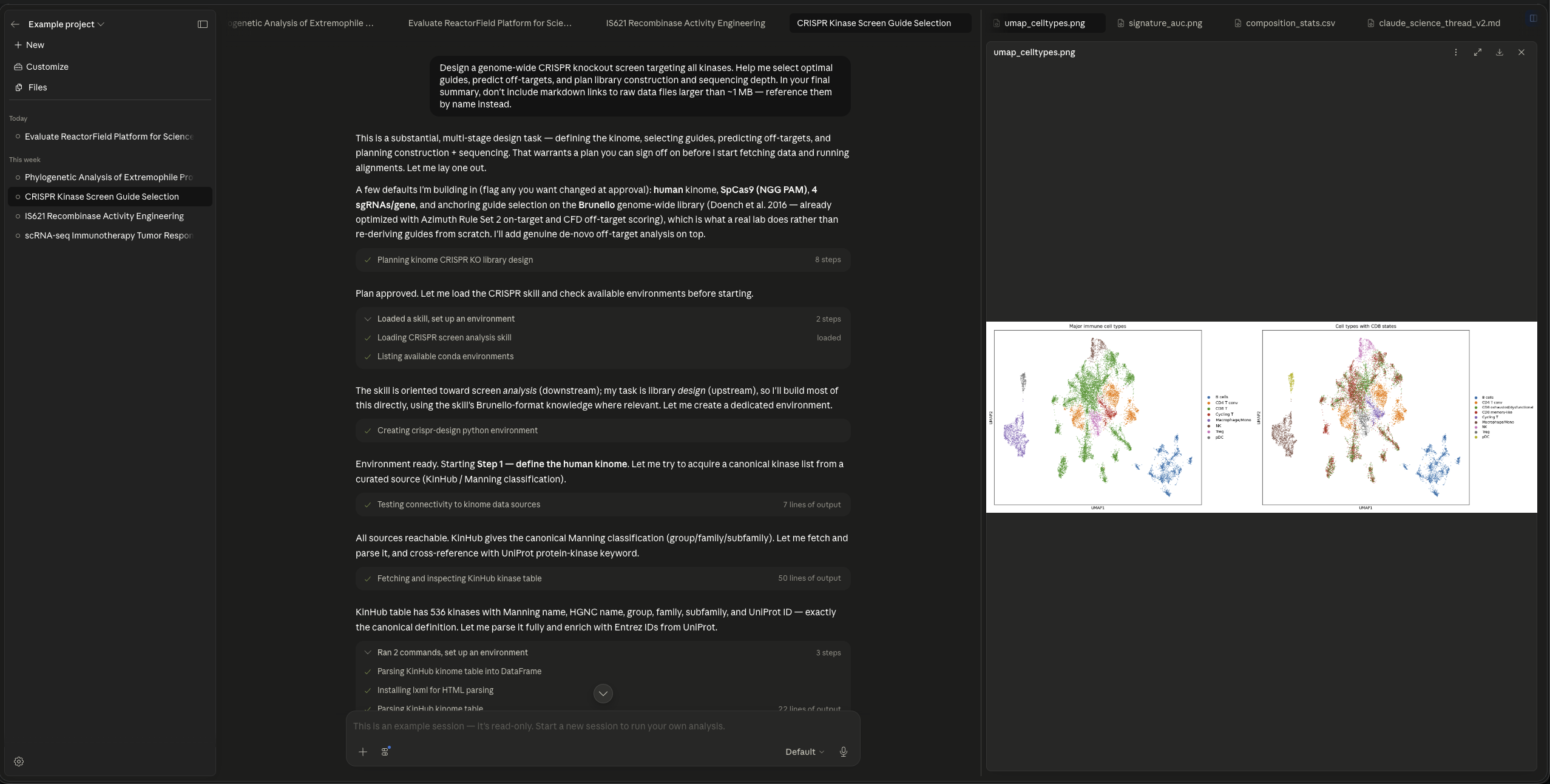
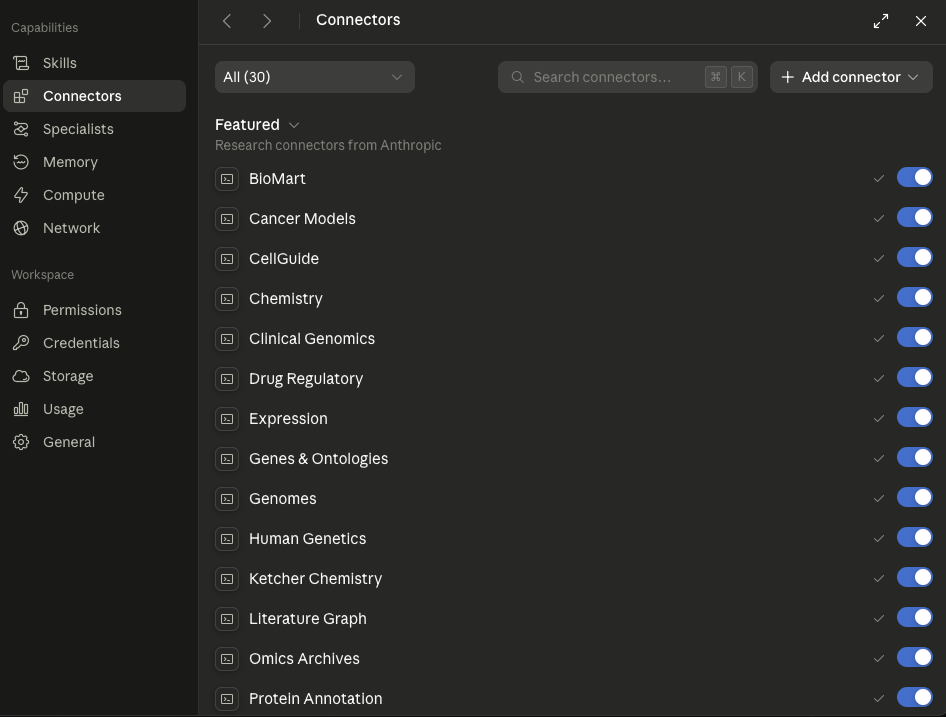
It comes pre-configured for genomics, proteomics, structural biology, cheminformatics, and more, with 60+ databases and tools already connected.
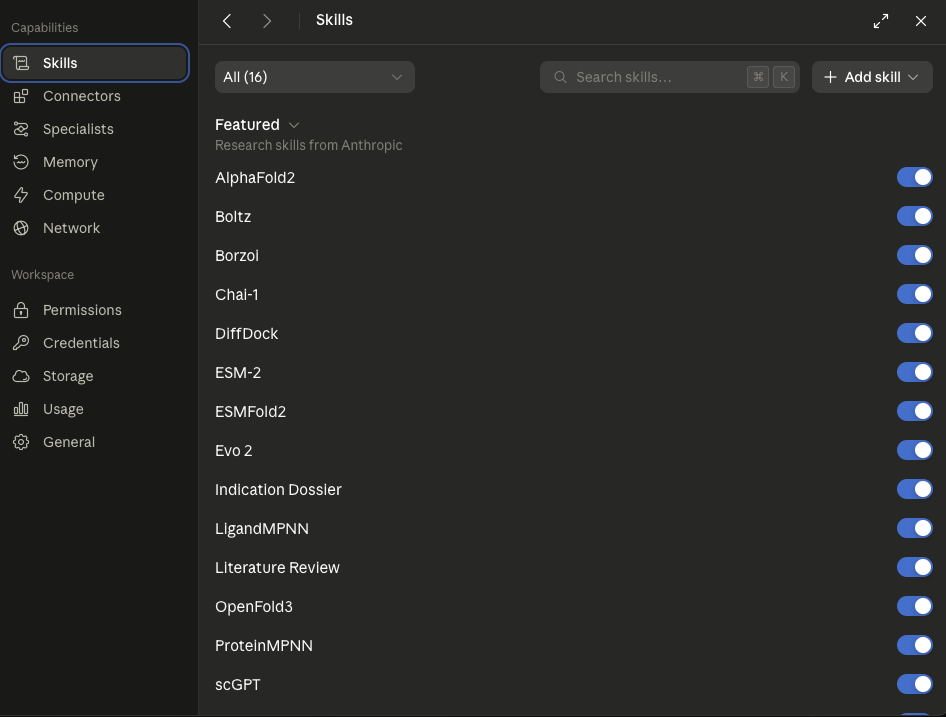
Those tools show up as skills: AlphaFold2, Boltz, Evo 2, ProteinMPNN, and more. Each one packages a method, a model, or a workflow the agent reaches for only when the task calls for it.
A reviewer agent checks the work at every step, flagging citations that don't hold up and numbers you can't trace back.
Every figure comes with the exact code, the environment, and the message history that made it. This enhances reproducibility. You can trace how any result was produced.
- You type a goal in plain English: "Design a focused CRISPR knockout screen across the human kinome. Pick guides, score off-targets, plan construction, representation, and sequencing."
- It plans and waits for approval: The goal yields an 8-step plan with named defaults kinome resolved on HGNC-stable IDs (not symbols), SpCas9, the Brunello library (Rule Set 2 on-target, CFD off-target scoring) and surfaces the scope calls you have to make: pseudokinases in, the class I PI3K lipid kinases excluded unless you say otherwise, and no cell line or readout named yet. Nothing is fetched until you approve.
- Sub-agents execute: They assemble the kinome from KinHub and UniProt keyed on stable IDs, subset Brunello to those genes, pull GRCh38, and enumerate off-targets genome-wide (Cas-OFFinder + CFD, ≤3 mismatches, NGG/NAG) — prioritizing candidate cut sites, not "predicting" them.
- Review agents audit the whole set, not samples: A full identity check against HGNC and InterPro caught STK19 carried by UniProt and the Human Protein Atlas as "serine/threonine kinase 19," so it enters a kinome built from names and keywords, yet its crystal structure has no kinase domain: it's a DNA-repair protein wearing a kinase's name, and only checking structure, not the label, catches it.
A paralog scan flagged every guide that multi-targets a family member SIK1's four guides all map to the near-identical SIK1B locus carried in GRCh38 plus every close paralog missing from the library, since that redundancy, not any design bug, is what buffers single-knockout phenotypes. - You get back to work: A subsetted library with the targeting-vs-control split stated (non-targeting, safe-harbor, and essential-gene controls included), six figures, and a report that fixes the readout, cell line, Cas9 status, MOI, and fold-representation — because those, not read depth, decide whether the screen works. Every figure carries its code.
Not a magic wand, but a path to an exponential shift
Aside from all the hype, this is not a magic wand.
Claude Science will still hallucinate. It can invent a citation for a paper that was never written, grab the wrong gene when two share a name, or hand you a confident number that's quietly wrong.
And there's a harder problem than mistakes. Science's toughest step is forming a good worthy hypothesis. You can't test them the way you test code. Software runs fast: you compile it, and the machine tells you instantly if you were wrong. Science doesn't work like that. The real test happens in a wet lab weeks or months later, and often the answers can still be ambiguous.
Yet I'm cautiously optimistic, because I've seen this shape before.
Compare Claude Code in March 2025 to now. It got exponentially better, and I'm still a little speechless at how much it changed the way I get things done. What improved fastest wasn't just the models. It was the harness around them.
Science is stepping onto that same curve now.
AI-native mindset for science
Software engineers got there first. AI changed how they build, top to bottom. Many of the best engineers write code by speaking into Telegram and forming loops.
Scientists are the next.
$Trillion companies betting on it. The tools shipped. Now it's time to learn how to use them well and adopt the AI-native mindset.
That's why we built Reactorfield with James Sinka, a four-week fellowship for scientists that accelerates R&D by embedding agents into scientific workflows.
I'll be writing more about AI x science. If you're a deep founder or scientist, consider applying to our program. And if you're building AI solutions for science, shoot me an email berk@reactorfield.com.